Stay informed with the latest legal insights and news.
Our blog features a variety of articles that cover important topics related to family law, estate planning, business law, and more.
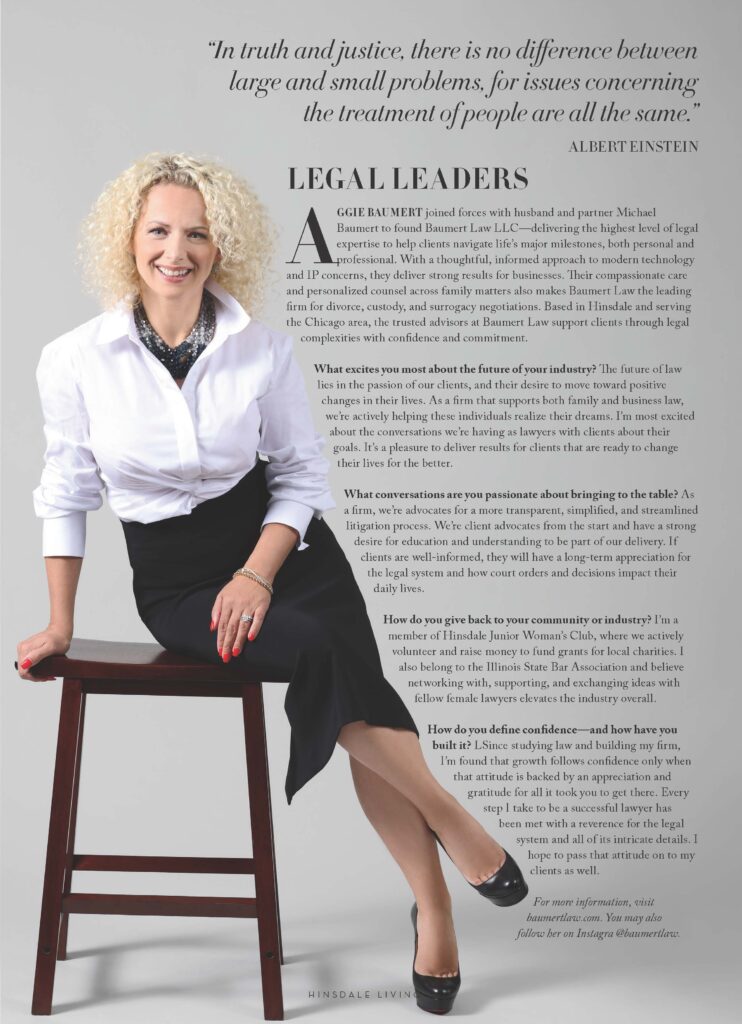
Celebrating Aggie Baumert: A Hinsdale Living Power Woman
What a joy to celebrate Aggie Baumert, our partner and founder, in her feature with Hinsdale Living’s Power Women! This recognition is so meaningful because it shines a light on what Aggie truly represents: ✨ Bringing clarity and confidence to clients during life’s most difficult...
We’re excited to be featured in the August 2025 edition of Hinsdale Living!
This month’s Features spotlight shines on us, Aggie and Michael Baumert, Principals of Baumert Law, and the work we’re proud to do both inside and outside the courtroom. From family law and estate planning to business and IP matters, we built Baumert Law to guide...
Surrogacy is more than a process—it’s a path to building a family when other doors may feel closed. Whether you are intended parents exploring your options or a woman considering becoming a surrogate, understanding how the journey works is an important first step. Legal protections,...
Client Testimonial: Why Clients Turn to Baumert Law
We’re proud to share another client testimonial that speaks to the care and determination behind every case we take on. “Aggie Baumert was perfectly helpful, professional, organized, driven, and most importantly, successful. She made a very difficult experience more manageable than I could have imagined,...
Between 𝟑𝟓% and 𝟓𝟎% of first-time marriages in the U.S. end in divorce. That number climbs to around 𝟔𝟎% for second marriages and over 𝟕𝟎% for third or later marriages. These numbers might sound high, but they’re real—and they reflect just how common divorce has...
Divorces often take several months to finalize. In the meantime, temporary orders can address urgent matters like spousal support, who stays in the home, or how bills are paid. These orders provide stability while the larger issues are worked out. If you’re considering divorce and...
Celebrating Aggie Baumert: A Hinsdale Living Power Woman
What a joy to celebrate Aggie Baumert, our partner and founder, in her feature with Hinsdale Living’s Power Women! This recognition is so meaningful because it shines a light on what Aggie truly represents: ✨ Bringing clarity and confidence to clients during life’s most difficult...
We’re excited to be featured in the August 2025 edition of Hinsdale Living!
This month’s Features spotlight shines on us, Aggie and Michael Baumert, Principals of Baumert Law, and the work we’re proud to do both inside and outside the courtroom. From family law and estate planning to business and IP matters, we built Baumert Law to guide...
Surrogacy is more than a process—it’s a path to building a family when other doors may feel closed. Whether you are intended parents exploring your options or a woman considering becoming a surrogate, understanding how the journey works is an important first step. Legal protections,...
Client Testimonial: Why Clients Turn to Baumert Law
We’re proud to share another client testimonial that speaks to the care and determination behind every case we take on. “Aggie Baumert was perfectly helpful, professional, organized, driven, and most importantly, successful. She made a very difficult experience more manageable than I could have imagined,...
Between 𝟑𝟓% and 𝟓𝟎% of first-time marriages in the U.S. end in divorce. That number climbs to around 𝟔𝟎% for second marriages and over 𝟕𝟎% for third or later marriages. These numbers might sound high, but they’re real—and they reflect just how common divorce has...
Divorces often take several months to finalize. In the meantime, temporary orders can address urgent matters like spousal support, who stays in the home, or how bills are paid. These orders provide stability while the larger issues are worked out. If you’re considering divorce and...